
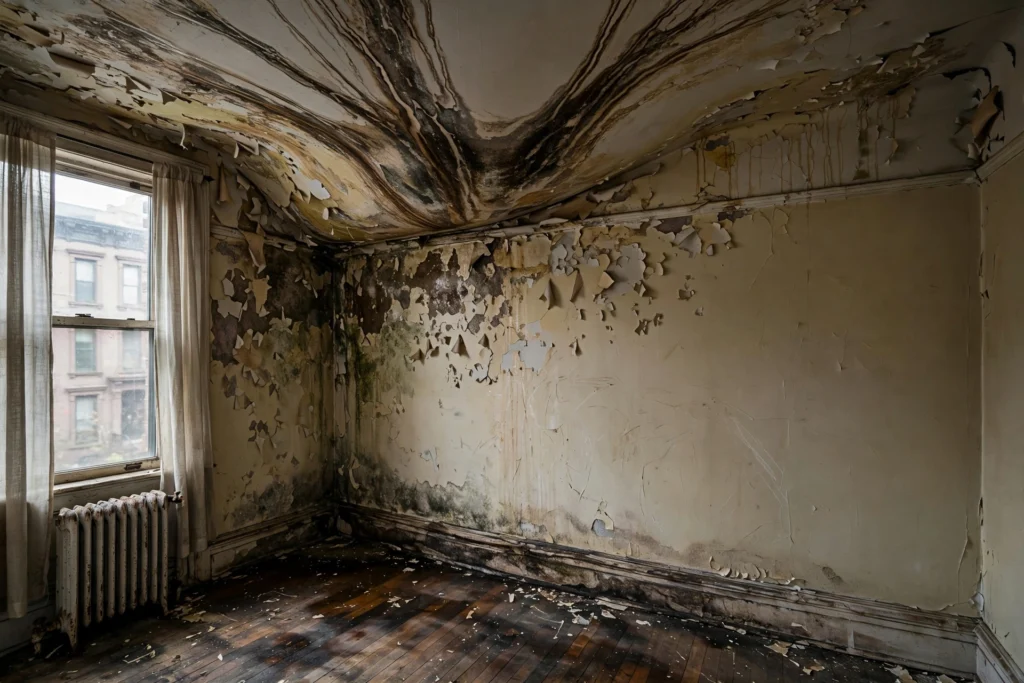
A burst pipe in January, a basement that floods every time it rains, a roof leak you didn’t notice until the ceiling started sagging — water damage is one of the most common reasons New York homeowners end up needing to sell fast. It scares off traditional buyers, complicates mortgage approvals, and can turn a straightforward listing into months of stalled negotiations. But a water-damaged house is far from unsellable. Thousands of New York homeowners sell homes with water damage every year, and those who understand their options consistently walk away with better outcomes than those who list blindly and hope for the best.
This guide covers everything you need to know about selling a house with water damage in New York: what counts as water damage, what New York’s disclosure laws require of you, why conventional buyers struggle with these properties, what your three real options are, and how to price your home so it actually sells.
What Counts as Water Damage When Selling a House in NY?
Water damage isn’t just a flooded basement. In the New York market, buyers, inspectors, and insurers treat the following as water damage, and all of it matters at sale time:
- Active leaks: burst or corroded pipes, leaking roofs, failed flashing, or compromised gutters that are still letting water in.
- Historical damage: past flooding or leaks that were dried out but never properly remediated — warped flooring, swollen drywall, or water-stained ceilings.
- Basement and foundation seepage: chronic dampness, efflorescence on basement walls, or water intrusion during heavy rain.
- Mold growth: mold is water damage’s near-constant companion. Visible mold — or the musty smell that signals hidden mold — is treated as part of the same problem.
- Structural rot: rotted subflooring, framing, or sill plates caused by long-term moisture exposure.
The key point: even if the leak stopped years ago, the visible evidence and the underlying damage still affect your sale. Buyers’ inspectors will find it, lenders will ask about it, and New York’s disclosure rules require you to address it honestly.
New York’s Seller Disclosure Rules for Water Damage
New York State’s Property Condition Disclosure Act requires sellers of 1-to-4 family homes to either complete a detailed property condition disclosure statement or give the buyer a $500 credit at closing in lieu of the disclosure. Most sellers choose the credit — but that choice does not give you a free pass to hide known defects.
Here’s what sellers commonly misunderstand:
- The $500 credit is not a licence to conceal. If you know about water damage and actively hide it — fresh paint over a water-stained ceiling, for example — you can still face legal liability for fraud, credit or not.
- “As-is” doesn’t override fraud either. Selling as-is means you’re not making repairs; it does not mean you can misrepresent the property’s condition. If a buyer asks directly about water history, you must answer truthfully.
- Mold has its own rules. In New York, professional mold remediation on larger jobs must be performed by a licensed mold remediator, and sellers should disclose known mold problems. For more on this specific angle, see our guide on selling a house with mold in New York.
Water damage can also trigger NYC Department of Buildings violations — for instance, if a leak has damaged structural elements or created unsafe conditions. Open violations attach to the property and complicate any sale, which is why we recommend reading our breakdown of selling a house with code violations in NYC if your property has outstanding violations.
The practical takeaway: disclose honestly, document what you know, and don’t spend money on cosmetic cover-ups. Serious buyers — especially cash buyers — price around known damage. They walk away from suspected concealment.
Why Traditional Buyers Walk Away From Water-Damaged Homes
Listing a water-damaged house on the open market with an agent is possible, but you should understand the headwinds before you commit months to the process.
Mortgage lenders are the biggest obstacle. Conventional, FHA, and VA loans all require the property to meet minimum condition standards. An appraiser who spots active water intrusion, significant mold, or structural rot will flag the property, and the lender will require repairs before funding the loan. FHA and VA appraisals are particularly strict. When the lender says “fix it first,” the buyer either pays for your repairs, renegotiates, or walks — and walking is what happens most often.
Insurance complications follow. A buyer who can’t get affordable homeowners insurance can’t close a mortgage. Properties with a history of water claims — especially in FEMA-designated flood zones common across parts of Brooklyn, Queens, Staten Island, and Long Island — can carry eye-watering premiums or require separate flood insurance policies. Many buyers simply move on to an easier property.
Inspection contingencies kill deals slowly. Even if you find a willing buyer, the inspection report becomes a renegotiation weapon. Every water stain becomes a demand for credits or repairs, and each round of negotiation adds weeks. The average “sale” of a water-damaged home through traditional channels frequently falls through once or twice before closing — if it closes at all.
None of this means listing is always wrong. But if your damage is significant, your timeline is tight, or you’ve already had a deal collapse, the traditional route’s costs in time, carrying costs, and stress deserve an honest accounting. Our analysis of what selling as-is actually costs walks through the real math.
Your Options: Repair, List As-Is, or Sell to a Cash Buyer
You have three genuine paths. The right one depends on the extent of the damage, your budget, and how fast you need to move.
Option 1: Remediate and Repair Before Listing
Full remediation makes sense when the damage is localised and the repair cost is clearly recoverable in the sale price — say, a single bathroom leak with contained damage in an otherwise solid house. Get a licensed contractor’s assessment, remediate any mold properly (New York requires licensed remediators for larger jobs), and keep all receipts and documentation. Documented professional repairs reassure buyers and appraisers alike.
Be realistic about the numbers, though. Water damage repairs in New York routinely run from a few thousand dollars for minor issues to $20,000–$50,000+ for basement flooding with structural involvement. Add the months of carrying costs — mortgage, taxes, insurance — while work is completed, and the “repair then list” route can easily cost more than the price premium it earns.
Option 2: List As-Is on the Open Market
Listing as-is means marketing the property in its current condition and pricing accordingly. You’ll attract investors and bargain-hunters alongside a few brave owner-occupants. Expect lower offers, inspection-driven renegotiations, and a longer time on market. You’ll still pay agent commissions (typically around 5–6% in the New York market, split between sides) on the reduced price, plus closing costs and months of carrying costs. For some sellers with minor damage and no urgency, this works. For significant damage, it often ends in price cuts that erase any advantage over a direct sale. Weigh the trade-offs in our pros and cons of selling as-is guide.
Option 3: Sell Directly to a Cash Buyer
Cash buyers — companies and investors who buy homes directly with their own funds — purchase water-damaged houses as-is, with no repairs, no listings, no showings, and no mortgage contingency to fall through. The offer reflects the property’s condition, but the seller skips agent commissions, avoids months of carrying costs, and typically closes in days or weeks rather than months.
This is the route most sellers with significant water damage ultimately take, because it converts an uncertain, months-long process into a certain, fast one. If that sounds like what you need, you can request a free cash offer for your New York house and see the numbers with no obligation.
What Do Water-Damaged Houses Sell For in New York?
There’s no single discount figure, but the pricing logic is consistent: buyers (and cash buyers’ offer formulas) start from the home’s after-repair value and subtract repair costs, a risk margin, and their required margin. In practice, water-damaged homes in New York sell for meaningfully less than comparable undamaged homes — the deeper and more structural the damage, the wider the gap.
A few factors move the number:
- Active vs. historical damage. An ongoing leak costs more to resolve — and scares buyers more — than damage from a fixed, documented past event.
- Structural involvement. Cosmetic staining is a minor discount; rotted framing, compromised sill plates, or foundation seepage (see our guide to selling with foundation problems) command a major one.
- Mold presence. Visible or suspected mold adds remediation cost and buyer fear in roughly equal measure.
- Location. A water-damaged house in a high-demand neighbourhood still attracts strong investor interest; the same house in a soft market has less leverage.
Whatever route you choose, get the repair estimate first. A contractor’s written assessment is the single most useful document in the process — it grounds your pricing, your negotiations, and your decision between repairing and selling as-is.
Common Sources of Water Damage in NYC and Long Island Homes
New York’s housing stock has some characteristic vulnerabilities worth knowing, whether you’re assessing your own property or evaluating one you’re considering:
- Ageing roofs and parapets. Many NYC rowhouses and Queens and Brooklyn multi-families have flat or low-slope roofs where failed membranes and clogged drains cause slow, hidden leaks.
- Old plumbing. Pre-war buildings across the five boroughs still run original or decades-old supply and waste lines. A single burst pipe can do five figures of damage in hours.
- Basement flooding. High water tables on Long Island and in parts of Queens and Brooklyn mean basements flood during heavy rain — a recurring problem, not a one-time event.
- Storm and flood zones. Post-Sandy, buyers and insurers pay close attention to flood-zone designation in coastal Brooklyn, Queens, Staten Island, and Long Island. A prior flood claim history follows the property.
- Neglected gutters and grading. The unglamorous cause behind a surprising share of foundation seepage: water with nowhere to go but in.
If your damage traces to one of these systemic causes, fixing the symptom without fixing the source just resets the clock — another reason sellers often prefer passing the project to a buyer equipped to handle it.
The Bottom Line: Selling a Water-Damaged House in New York
Water damage complicates a home sale, but it doesn’t prevent one. Disclose honestly, get a real repair estimate so you know what you’re dealing with, and choose your path with clear eyes: repair and list if the damage is minor and time is on your side, or sell as-is — ideally directly to a cash buyer — if the damage is significant, the timeline is tight, or you’ve already watched a traditional deal fall apart.
If you want a no-obligation number on your water-damaged New York house, get your free cash offer from Cash Buyers NY today. We buy houses in any condition across NYC and Long Island, close on your timeline, and handle all the paperwork.
Frequently Asked Questions
Can you sell a house with water damage in New York?
Yes. Water damage doesn’t prevent a sale, but you must disclose known damage honestly under New York’s Property Condition Disclosure Act, and traditional buyers’ mortgage lenders may require repairs before funding. Many sellers of water-damaged homes sell directly to cash buyers to avoid lender complications.
Do I have to disclose water damage when selling my house in NY?
You must either complete the state’s property condition disclosure statement or give the buyer a $500 credit at closing. Even with the credit, actively concealing known water damage can expose you to fraud liability. When in doubt, disclose.
Will a mortgage lender approve a buyer for a water-damaged house?
Often not without repairs. Conventional, FHA, and VA appraisers flag active water intrusion, significant mold, and structural damage, and lenders typically require those issues to be resolved before funding the loan. This is the most common reason traditional deals on water-damaged homes collapse.
How much less is a house with water damage worth?
It depends on severity. Minor, repaired cosmetic damage has a small effect; active leaks, structural rot, or mold problems command a substantial discount reflecting repair costs plus buyer risk. A contractor’s written repair estimate is the best basis for pricing.
Should I fix water damage before selling or sell as-is?
Fix it if the damage is localised and the repair cost is clearly recoverable in a higher sale price. Sell as-is — often directly to a cash buyer — if the damage is extensive, you lack the budget or time for repairs, or a traditional listing has already stalled or fallen through.

Jeff is part of the team at Cash Buyers NY, a cash home-buying company serving New York City and Long Island from Bellerose, Queens. The company buys houses as-is in any condition — no repairs, no agents, no commissions, and no financing contingencies — through a straightforward cash-offer process. Jeff covers the questions New York homeowners actually ask: how long a cash sale takes, what it costs, how co-op boards and inheritance work, and when selling as-is makes sense.