
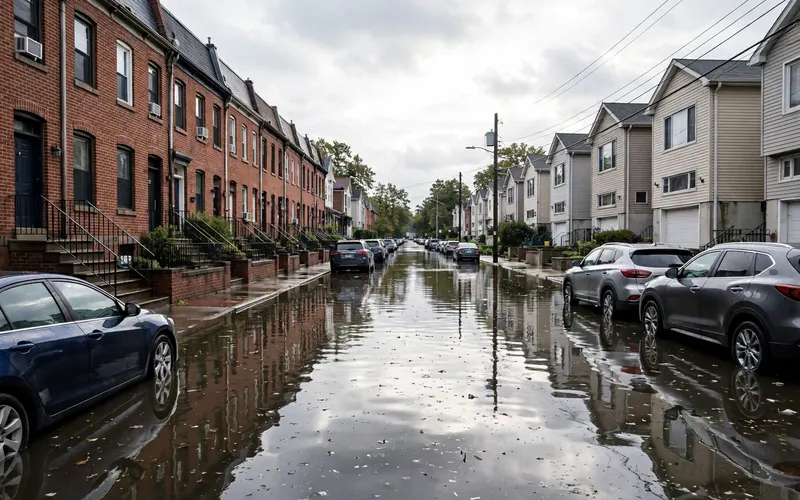
Flood insurance used to be a forgettable line item on a New York homeowner’s budget — a few hundred dollars a year, paid quietly through escrow. For thousands of homeowners across the five boroughs and Long Island, that era is over. Under FEMA’s Risk Rating 2.0 pricing, premiums have been climbing year after year, and some owners in coastal neighborhoods now face bills in the thousands. For owners already stretched by property taxes, maintenance, and a mortgage, the insurance bill has become the tipping point — the reason they decide to sell their house fast in New York instead of carrying another year of rising costs.
Here is what is driving the increases, what NYC-area owners are actually paying, and when selling as-is starts to make financial sense.
Why Flood Insurance Bills Keep Rising in New York
FEMA’s Risk Rating 2.0 and the 18% “Glide Path”
In October 2021, FEMA overhauled how the National Flood Insurance Program (NFIP) prices policies. The new method, Risk Rating 2.0, sets each premium from property-level factors — distance to water, elevation, flood frequency, rebuild cost, and the type of flooding a home faces — instead of relying mainly on whether the address sits inside a mapped flood zone.
New policies have been priced at full risk since the change, while older policies were not repriced overnight. Federal law caps most annual increases at 18%, so existing policyholders ride what the industry calls a “glide path”: premiums rise by up to 18% every year until they reach the property’s full-risk rate. According to 2026 research from Neptune Flood, the median cost of a new NFIP policy rose from $593 in 2021 to $1,134 through mid-2026 — a 91.2% jump — and the Government Accountability Office does not expect the phase-in to finish until 2037. That means many homeowners have more than a decade of scheduled increases ahead of them. Read Neptune Flood’s five-year analysis of NFIP pricing.
New Flood Maps Could Sweep More NYC Homes Into High-Risk Zones
On top of repricing, the maps themselves are in play. New York City’s effective flood maps are more than 20 years old. FEMA proposed updated maps in 2015 that would have added roughly 35,500 properties to high-risk zones, but the city appealed — and a decade later that appeal remains unresolved, according to a 2026 analysis from Neptune Flood. See the deep dive on FEMA flood map gaps.
Whenever new maps take effect, properties newly placed in a Special Flood Hazard Area with a federally backed mortgage will face mandatory flood insurance purchase. FEMA offers a “Newly Mapped” discount that phases out over time, softening the first years, but the long-run direction is the same: higher premiums for more homes. Policygenius breaks down New York flood insurance costs by zone.
What NYC-Area Homeowners Are Actually Paying
National averages tell part of the story. Industry reporting puts the typical NFIP policy at about $1,100 a year — up roughly 90% over five years. A peer-reviewed study found that Risk Rating 2.0 cut new NFIP policies by 11% to 39% and existing policies by 5% to 13%, with the biggest drops where premiums rose most. Read the reporting on vanishing flood coverage.
In New York, the spread is wide. Policygenius data puts the average for high-risk (A or V zone) properties around $2,019 a year, versus about $671 in moderate-to-low-risk zones. Borough-level estimates from one flood-insurance provider run roughly $830 a year in Broad Channel, $727 in Brooklyn, $723 in the Bronx, and $647 in Far Rockaway — though any single address can land far above or below those figures depending on elevation and distance to water. See BetterFlood’s borough-level New York estimates.
The more honest way to read these numbers: your bill is specific to your property, and under the glide path it is scheduled to keep rising until it reflects your full risk. Ask your agent for your property’s full-risk rate and how many years of increases remain — that figure matters more than any average.
The Neighborhoods Feeling It Most
Flood risk in the five boroughs concentrates along the water, and Hurricane Sandy’s surge map still predicts the pressure points: Broad Channel and the Rockaway peninsula in Queens (which take water from both the Atlantic and Jamaica Bay), Canarsie, Sheepshead Bay, Gerritsen Beach, Coney Island, and Red Hook in Brooklyn, the East and South Shores of Staten Island, and the Hutchinson River, Bronx River, and City Island waterfronts in the Bronx. Tropical Storm Ida added another lesson: flash flooding now reaches well beyond the shoreline, and basement apartments on low-lying inland blocks carry real risk too.
How Rising Premiums Affect What Your Home Is Worth
Flood insurance does not just cost you money each year; it changes what buyers will pay. A $2,000 annual premium adds about $167 a month to a financed buyer’s housing cost, directly reducing the mortgage they qualify for — and the offer they can make. Conventional buyers who need financing in a high-risk zone must carry the insurance, which shrinks the buyer pool. And appraisers account for carrying costs, so two otherwise identical homes with very different premiums do not sell for the same price.
Research circulated by the Federal Reserve Bank of Dallas projects that continued premium increases could push roughly 203,000 additional mortgages per year into delinquency between 2025 and 2055 — and notes that homeowners unable to absorb the costs may end up forced to sell. Read the analysis on insurance costs and forced sales. If you are already deciding between holding and selling, run the honest math: total annual carrying costs against what your equity earns you — not just the insurance line alone.
What to Do Before You Decide to Sell
A rising premium is not always a final number. Before concluding that selling is the answer, work through these:
- Confirm your flood zone. Look up your address on FEMA’s Flood Map Service Center and check whether preliminary maps change your designation. Your current zone — and any pending change — drives everything else.
- Get your full-risk rate. Ask your NFIP agent what your property’s full-risk premium is and how many years of capped increases remain. If you are near the end of the glide path, the worst increases may be behind you.
- Consider an elevation certificate. Under Risk Rating 2.0 it is not required, but if FEMA’s elevation estimate for your home is wrong, a licensed survey can lower your premium — and providing one can never raise it.
- Shop the private market. Private flood insurers price to current risk without the NFIP glide path, and some quotes come in lower. Compare carefully: private carriers can non-renew, while the NFIP cannot drop you for risk.
- Ask about discounts. Pre-FIRM and newly mapped properties may qualify for statutory discounts, and NFIP discounts are generally transferable to a buyer when you sell — a genuine selling point in a flood-zone transaction.
When Selling As-Is Starts to Make Sense
None of the above helps if the underlying math does not work: a home with years of scheduled increases, in a neighborhood where buyers discount for flood risk, where you are tired of carrying the cost. In that situation, selling as-is — to a buyer who does not need a mortgage and is not bound by a lender’s flood insurance requirement the way a financed buyer is — can be the clean exit. It also sidesteps the inspection and appraisal friction that flood-zone homes often hit with financed buyers. If you are weighing it, it helps to know how long a cash sale takes in NYC compared with a traditional listing: typically days to a couple of weeks from offer to close rather than months.
Be honest about the alternatives: listing traditionally means the buyer inherits the same insurance math and will negotiate on it; holding means absorbing the increases. Selling a home with water damage or chronic flood exposure as-is simply moves the property to someone equipped to handle it.
Frequently Asked Questions
How much does flood insurance cost for NYC-area homeowners?
It varies widely by property. High-risk zone (A or V) properties in New York average around $2,019 a year, while moderate-to-low-risk zones average about $671, according to Policygenius. Borough-level estimates range from roughly $647 in Far Rockaway to about $830 in Broad Channel. Your own premium depends on elevation, distance to water, and where your property sits on the Risk Rating 2.0 glide path.
Do I need flood insurance if my home is not in a high-risk flood zone?
Not legally — unless your lender requires it. But more than 20% of flood claims come from outside high-risk zones, and Tropical Storm Ida proved inland New York City blocks can flood. Coverage in lower-risk zones is comparatively cheap and worth considering.
Will my flood insurance premiums keep rising every year?
If your current premium is below your property’s full-risk rate, yes — federal law allows increases of up to 18% per year until the two meet, and the phase-in is expected to run into the 2030s. Ask your agent for your full-risk rate to see how many years of increases remain.
Can I transfer my flood insurance discount to a buyer when I sell?
In most cases, yes. NFIP policyholders can generally assign their policy — including applicable discounts — to the new owner at sale. That can be a genuine selling point in a flood-zone transaction.
Does regular homeowners insurance cover flood damage?
No. Standard homeowners policies exclude damage from rising water. You need a separate flood policy through the NFIP or a private insurer.
The Bottom Line
Rising flood insurance costs are a real, structural reason New York homeowners are choosing to sell — not a market fad. With premiums climbing up to 18% a year toward full-risk rates, new maps potentially adding tens of thousands of properties to high-risk zones, and buyers discounting offers for carrying costs, the decision to hold or sell deserves honest math, not hope.
If the numbers tell you it is time, you do not have to list and wait. Cash Buyers NY buys homes directly across New York City and Long Island, in as-is condition — flood-zone history, water damage, and all. Call 646-920-8900 or get a free cash offer online to see what your home could bring without the listing wait.

Jeff is part of the team at Cash Buyers NY, a cash home-buying company serving New York City and Long Island from Bellerose, Queens. The company buys houses as-is in any condition — no repairs, no agents, no commissions, and no financing contingencies — through a straightforward cash-offer process. Jeff covers the questions New York homeowners actually ask: how long a cash sale takes, what it costs, how co-op boards and inheritance work, and when selling as-is makes sense.