
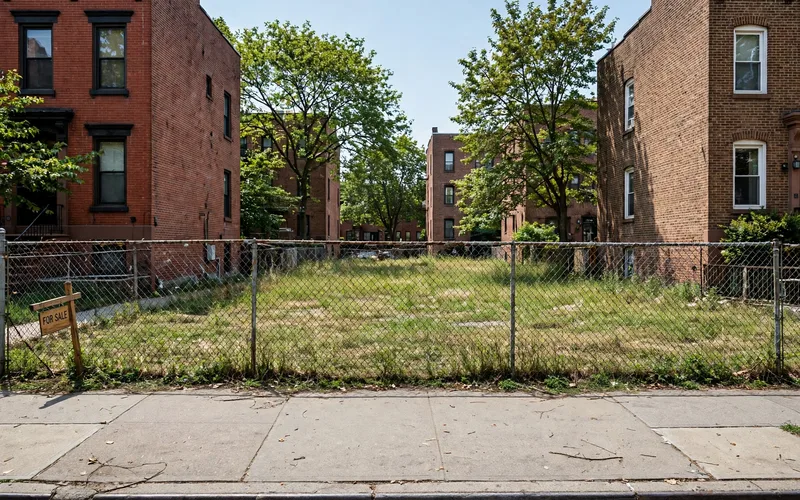
An empty lot in New York City or on Long Island can be worth a great deal — or far less than its owner expects. Unlike a house, a vacant parcel has no kitchen to renovate and no roof to replace, so buyers judge it on a different set of questions: what can be built there, how big, and what will it cost to get permission? This guide explains how selling vacant land works in New York, what to check before you list, and which selling route fits your situation. If you need to sell your house fast in New York, the process is different — but many landowners hold both a house and a spare lot, so it helps to understand where the two sales diverge.
Vacant Land Is Not the Same as a Vacant House
A vacant house still has walls, a roof and a floor plan a buyer can walk through. A vacant lot has none of that, so the buyer is really purchasing potential: the right to build something, at some size, at some future date. That makes the buyer pool narrower and more specialised — mostly developers and builders, neighbouring owners who want extra garden or parking space, and investors holding land while an area develops.
The distinction also matters for paperwork. New York’s Property Condition Disclosure Statement, which sellers of one-to-four family homes must complete, does not apply to unimproved land. A vacant property with a house on it is a different sale entirely, with different buyers, pricing and risks.
What Determines What Your Lot Is Worth?
Two lots on the same street can sell for very different prices. Land value in New York comes down to what a buyer can do with the parcel, and four factors dominate the calculation.
Zoning and buildable area
Zoning sets the use, size and height of whatever can be built. The floor area ratio (FAR) is the key number: it fixes how many square feet of building area the lot supports. A 25-by-100-foot lot in an R6 district can carry far more building than the same lot in an R2 district, and a manufacturing (M) district may not allow housing at all. Developers price land by buildable square feet, not lot size alone.
Location, shape and frontage
Corner lots and wide lots are easier to design around and usually command a premium. For land, the key question is whether builders are active in the area right now.
Utilities, sewer and septic
A lot with water, sewer and electric connections at the kerb is worth more than one without them, because bringing services in can cost tens of thousands of dollars. On Long Island, much of Suffolk County is not sewered, so a buyer must budget for a septic system — and the county requires advanced nitrogen-removing systems for new construction in many areas. A parcel that fails a percolation test, or sits on wetlands, may not be buildable at all.
Comparable land sales
Land sells less often than houses, so comparable sales are thinner and older. A good valuation looks at recent sales of similar lots with similar zoning, not at the price of finished houses nearby.
Check the Zoning Before You Set a Price
Before you talk numbers with anyone, look up the lot on the New York City Department of City Planning’s ZoLa (Zoning and Land Use Application). ZoLa shows the zoning district, the FAR, height and setback rules, and whether the lot sits in a special district, a flood zone or a historic district. In Nassau and Suffolk counties, the equivalent check is the town or village zoning map and code, usually available from the municipal building department.
Confirm the lot is actually buildable. Some parcels are landlocked, lack legal street frontage, sit partly in mapped wetlands, or carry an easement that blocks construction — such as a shared driveway or utility easement running across the middle. Recent City of Yes zoning reforms may also have changed what can be built on some lots, so a zoning check done a few years ago may be out of date. Due diligence guides for New York property recommend checking zoning, title records and building department records together, and a current survey showing exact boundaries, easements and encroachments is one of the most persuasive documents you can hand a land buyer.
Title, Survey and Back Taxes: Clear These Before You List
Vacant lots often carry the messiest title histories of any property type. Many were inherited, split off from a larger parcel decades ago, or held by an owner who stopped paying attention — and sometimes stopped paying taxes — years ago. All of that shows up when a buyer’s attorney orders a title search, so run the checks early. In New York City, the Department of Finance’s ACRIS system lets you search recorded deeds, mortgages and liens for your parcel by block and lot: look for old mortgages never discharged, tax liens, judgments and boundary disputes. If the lot came through an inheritance, confirm the estate was properly settled and the deed is in your name.
Unpaid property taxes deserve special attention. In New York City, unpaid taxes can become a lien that the city may sell in its annual tax lien sale; on Long Island, the county can eventually foreclose. Either way, arrears come out of your proceeds at closing — find out the amount before you agree a price.
Do You Need a Property Condition Disclosure Statement?
No. New York’s Property Condition Disclosure Act requires sellers of residential real property to complete a disclosure statement before the buyer signs a contract — but the law defines residential real property as a one-to-four family dwelling and expressly excludes unimproved land. The statute, New York Real Property Law § 462, sets out the requirement, and Nolo’s summary of New York disclosure law confirms vacant land is outside it.
That does not mean you can stay silent about problems you know about. New York is still a caveat emptor state for matters the disclosure law does not reach, but a seller may not actively conceal a known defect — for example, hiding the fact that part of the lot is contaminated, or that a previous soil test failed. Disclose known environmental issues, a buried oil tank, a wetlands designation or a failed perk test: a buyer who discovers it later will either walk away or renegotiate, and a concealed problem can become a legal dispute after closing.
Taxes When You Sell Vacant Land in New York
Tax is where land sales surprise owners most, because the rules that shelter home sellers usually do not apply.
Profit on a land sale is a capital gain. If you owned the lot for more than one year, the gain is taxed at the federal long-term rates of 0%, 15% or 20%, depending on your income; held for a year or less, it is taxed as a short-term gain at your ordinary income rate, which can reach 37%. Guidance on capital gains for land sales confirms the distinction and notes inherited land is treated as long-term even if you sell soon after inheriting it.
The $250,000 ($500,000 for married couples filing jointly) primary residence exclusion under Internal Revenue Code § 121 does not apply to a standalone vacant lot — there is no home to have lived in. The narrow exception is land adjacent to your principal residence, used as part of it and sold within two years of the home sale — a question for a tax adviser, not something to assume.
If the lot was held for investment or business use, a 1031 exchange can defer the capital gains tax by reinvesting the proceeds in like-kind property — raw land held for investment is generally like-kind to other real estate. The rules are strict, with a 45-day identification deadline and a 180-day closing deadline, so use a qualified intermediary. Our landlords’ guide to the 1031 exchange explains the timelines and the common mistakes.
Transfer taxes also apply at closing. New York State charges 0.4% of the price ($2 per $500 of consideration), per the Department of Taxation and Finance, and New York City adds its own Real Property Transfer Tax — 1% up to $500,000 and 1.425% above that for residential transfers, or 1.425%/2.625% for other property, according to NYC 311’s RPTT guidance. The 1% mansion tax applies to residences of $1 million or more, so a bare lot usually falls outside it — confirm that with your attorney. On eastern Long Island, the Peconic Bay Community Preservation Fund tax adds a further 2% (plus a 0.5% housing surcharge in four of the five East End towns), with a partial vacant-land exemption of $100,000 or $75,000 depending on the town.
Three Ways to Sell Vacant Land in New York
List it with an agent. A listing puts the lot in front of the widest pool of developers and investors, and a good land agent knows how to present zoning, FAR and survey information so buyers can underwrite the site. The trade-off is time and cost: land often takes longer to sell than a house, and you pay a commission. A realistic asking price from day one matters more than it does for houses, because land buyers assume an overpriced lot is a distressed one.
Sell directly to a developer or investor. If builders are active in your area, approaching developers directly — or through an attorney or land broker — can produce a faster sale with no listing period and no commission. Developers buy on the numbers: zoning, buildable area and their construction costs, discounted for the risk, time and cost of approvals. Get more than one offer if you can; a single developer’s number is not a market price.
Sell as-is, without repairs or preparation. Land rarely needs preparation, but the as-is principle still applies: you sell the parcel in its current condition, with no obligation to clear it, grade it or obtain approvals first. If your parcel also has a house on it, a cash buyer can be a realistic option — Cash Buyers NY buys houses as-is across New York City and Long Island, including a vacant home that needs work. For a bare lot with no structure, a developer or land investor is the more natural buyer, and your attorney can help you reach them.
Whichever route you choose, use a New York real estate attorney. New York is an attorney state for closings, and a land sale has more moving parts than a standard house sale: easements, zoning contingencies, title issues and tax elections all sit in the contract.
Frequently Asked Questions About Selling Vacant Land in NYC
Can I sell vacant land in New York without a real estate agent?
Yes. You can sell directly to a developer or investor, or market the lot yourself. In New York you will still need a real estate attorney for the contract and closing, and a title company to clear title and record the deed. An agent’s value is mainly access to developer buyers and help pricing the lot.
Do I have to pay capital gains tax when I sell vacant land?
Usually, yes. Profit on a land sale is a capital gain, taxed at long-term rates of 0%, 15% or 20% if you held the lot for more than a year, and at ordinary income rates if you held it for a year or less. The primary residence exclusion does not apply to a standalone lot. A 1031 exchange may defer the tax if the land was held for investment — talk to a tax adviser before you close.
Does the Property Condition Disclosure Statement apply to vacant land?
No. Under New York Real Property Law § 461(5), the disclosure statement applies only to one-to-four family dwellings, and unimproved land is expressly excluded. You should still disclose known problems such as contamination, wetlands or a failed soil test, because actively concealing a known defect can create legal trouble even where the disclosure form does not apply.
How long does it take to sell vacant land in New York City?
It varies widely. A lot in an active development area with clear zoning and clean title can sell to a developer in weeks. A lot that needs a zoning check, a survey, title work or a septic approval can take months, because the buyer’s due diligence is longer than for a house. Lots with title problems or unpaid taxes take longest of all — which is why clearing those issues before you list is the fastest thing you can do.
The Bottom Line
Selling vacant land in New York City or on Long Island is a different sale from selling a house, and it rewards preparation. Check the zoning, get a current survey, clear the title and tax picture, and understand the tax bill before you agree a price — because the buyers for land are professionals who will check all of it anyway. Priced on its buildable potential and presented with clean paperwork, a lot can sell well; priced on hope, it will sit.
If your property includes a house as well as land, the picture changes: a home can be sold as-is for cash without listing, repairs or showings. To find out what that route could look like for your house, request a free cash offer — there is no obligation. For a bare lot, your best next step is a conversation with a New York real estate attorney and a land broker who knows your neighbourhood.

Jeff is part of the team at Cash Buyers NY, a cash home-buying company serving New York City and Long Island from Bellerose, Queens. The company buys houses as-is in any condition — no repairs, no agents, no commissions, and no financing contingencies — through a straightforward cash-offer process. Jeff covers the questions New York homeowners actually ask: how long a cash sale takes, what it costs, how co-op boards and inheritance work, and when selling as-is makes sense.