
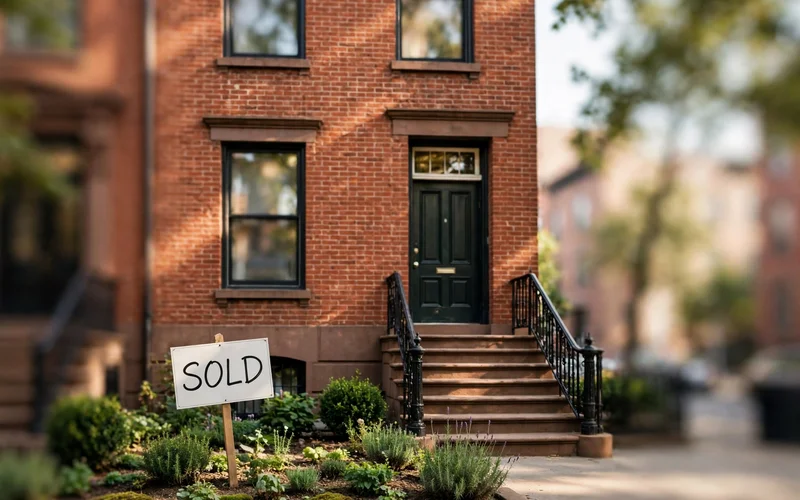
If you are selling a home in New York City valued at $1 million or more, there is a state transfer tax that will shape your transaction — even though you are not the one who pays it. New York’s “mansion tax” is paid by the buyer at closing, but its effects land on sellers: it influences how you price your home, how much leverage buyers have near the $1 million line, and how buyers calculate what your property truly costs them. Here is the seller’s guide:
What Is the NYC Mansion Tax?
Despite its name, the mansion tax has nothing to do with actual mansions. It is an additional New York State real estate transfer tax — officially the additional tax on transfers of residential real property — that applies to the sale of residential property anywhere in New York State when the sale price (the “consideration”) reaches $1 million or more. It was introduced in 1989 as a flat 1% charge and has applied to every qualifying residential sale since.
A few things make this tax unusual:
- It applies to the entire sale price, not just the amount above $1 million. A $1 million sale triggers a $10,000 tax, not a tax on $0.
- It is paid by the buyer, not the seller — one of the few New York transfer taxes that works this way.
- It applies statewide, but bites hardest in New York City, where a large share of home sales cross the $1 million threshold.
The New York State Department of Taxation and Finance publishes detailed guidance on the additional transfer tax, including which property types qualify and how the tax is calculated.
The 2019 Progressive Rate Tiers
The flat 1% mansion tax stood unchanged for thirty years. Then, effective July 1, 2019, New York added a progressive supplemental tax on top of it for residential sales in New York City, with the added revenue directed toward mass transit:
| Sale price | Base mansion tax | Supplemental tax | Combined rate |
|---|---|---|---|
| $1M to under $2M | 1% | — | 1% |
| $2M to under $3M | 1% | 0.25% | 1.25% |
| $3M to under $5M | 1% | 0.5% | 1.5% |
| $5M to under $10M | 1% | 1.25% | 2.25% |
| $10M to under $15M | 1% | 2.25% | 3.25% |
| $15M to under $20M | 1% | 2.5% | 3.5% |
| $20M to under $25M | 1% | 2.75% | 3.75% |
| $25M and above | 1% | 2.9% | 3.9% |
To put that in concrete terms: on a $1.5 million sale, the buyer owes 1% — $15,000. On a $2.5 million sale, the combined 1.25% rate means $31,250. These are real closing-table dollars, on top of the typical closing costs for sellers in New York that the seller side of the ledger carries.
Who Actually Pays the Mansion Tax?
The legal answer is clear: the buyer pays the mansion tax. It is reported and paid at closing, typically handled by the buyer’s closing attorney or title company on Form TP-584, the state’s Combined Real Estate Transfer Tax Return, due within 15 days after the deed is delivered.
But there are two important wrinkles sellers should know:
1. The seller is the backstop
If the buyer fails to pay the tax — or is exempt from it — the seller becomes liable, jointly and severally with the buyer. This is rare in ordinary arm’s-length sales, but it is why your attorney will confirm the tax was paid before the file closes.
2. Payment can be negotiated
Nothing in the law prevents the parties from agreeing, in the contract of sale, that the seller will cover part or all of the buyer’s mansion tax — for example, as a closing credit. Near the $1 million threshold this becomes a genuine bargaining chip: a buyer facing a $10,000 tax bill on a $1,000,001 purchase may ask the seller to absorb it, effectively pushing the negotiation back under the line.
Contrast this with the other transfer taxes in the deal, which are the seller’s responsibility: the New York State base transfer tax of $2 per $500 of consideration (0.4%), plus New York City’s own Real Property Transfer Tax. Those are covered in more detail in our guide to taxes that apply when selling a house in New York.
The $1 Million Cliff: Why Pricing Near the Threshold Matters
The mansion tax creates one of the sharpest “cliffs” in American real estate taxation. Consider two identical homes:
- Sold for $999,999: mansion tax = $0
- Sold for $1,000,000: mansion tax = $10,000 (1% of the entire price)
A single extra dollar in the contract price costs the buyer ten thousand dollars. That discontinuity has real consequences for sellers:
- Offer negotiations. Expect buyers near the line to model both outcomes. An offer of $1,005,000 with a request that the seller credit the $10,050 mansion tax is economically similar to a clean $995,000 offer — compare the net, not the headline number.
- Deal structure. The tax applies to the full consideration, which can include personal property bundled into the deal. Small add-ons that nudge the price over a threshold can have outsized tax consequences — review the contract price with your attorney before signing.
Does the Mansion Tax Apply to Co-ops and Condos?
Yes. For mansion-tax purposes, “residential real property” includes one-, two-, and three-family houses, individual condominium units, and cooperative apartment units. A four-family (or larger) multifamily building is not treated as residential real property under this rule, so its sale does not trigger the tax even above $1 million.
There is also a unit-by-unit rule worth knowing: when multiple condo or co-op units in the same building are sold to one buyer, each unit is generally evaluated separately against the $1 million threshold — unless the units have been combined or are used together as a single residence.
Co-op sellers face an additional NYC-specific layer on top of all this: the flip tax, a separate transfer fee charged by many co-op boards. It is a different tax with different rules, but it stacks onto the same closing statement.
What the Mansion Tax Means for a Cash Sale
Sellers sometimes assume that selling directly to a cash buyer sidesteps transfer-tax complications. It does not — the mansion tax still applies at closing in a cash transaction if the price is $1 million or more. The buyer, cash or financed, owes it.
What a cash sale does change is the surrounding economics: no mortgage recording tax, no lender-driven appraisal or delay, and no financing contingency that can collapse over an unexpected tax bill. A professional cash buyer factors every transaction cost into its offer, so the number you receive already reflects the real economics of the deal. If your priority is to sell your house fast in New York without listing, showings, or repair work, that certainty is the trade being made — and understanding the tax picture helps you evaluate any offer, cash or traditional, on its true net merits.
Common Misconceptions About the Mansion Tax
- “The seller pays the mansion tax.” No — the buyer pays it, with the seller liable only as a backstop if the buyer doesn’t pay or is exempt.
- “It’s 1% on the amount over $1 million.” No — it’s 1% (or the applicable tiered rate) on the entire sale price once the threshold is met. That’s what creates the cliff.
- “It’s an annual property tax.” No — it’s a one-time transfer tax paid at closing.
- “It only applies in Manhattan.” No — the base 1% tax applies statewide; the progressive supplemental tiers apply to conveyances in New York City. A $1.2 million sale on Long Island triggers the 1% base tax just the same.
- “There’s no way to plan around it.” Pricing, negotiation credits, and deal structure are all legitimate planning tools — but they belong in a conversation with your real estate attorney.
Frequently Asked Questions
Who pays the NYC mansion tax, the buyer or the seller?
The buyer pays the mansion tax at closing. The seller becomes liable only if the buyer fails to pay or is exempt from the tax, in which case the liability is joint and several. The parties can also negotiate in the contract for the seller to cover part of the tax as a closing credit.
How much is the mansion tax on a $1.5 million home in NYC?
One percent of the full sale price — $15,000 — paid by the buyer at closing. At $2.5 million, the combined rate is 1.25%, or $31,250. The supplemental tiers that raise the rate above 1% apply to residential conveyances in New York City.
Does the mansion tax apply to co-ops and condos in New York City?
Yes. Individual condominium units and cooperative apartment units count as residential real property for mansion-tax purposes, so a $1 million-plus co-op or condo sale triggers the tax. Each unit is generally measured separately unless the units are combined or used as one residence.
If I price my home at $999,999, do I avoid the mansion tax?
The tax is the buyer’s obligation, but pricing just under $1 million means no mansion tax is triggered at all — which can make your home more attractive to buyers budgeting their closing costs. Discuss the trade-offs with your real estate attorney before setting a price.
Has the mansion tax changed recently?
The structure has been stable since the 2019 amendments: a 1% base tax on residential sales of $1 million or more, plus progressive supplemental tiers in New York City topping out at a combined 3.9%. A review of the 2026 state budget debate found the tax unchanged, though proposals to alter the threshold surface in Albany from time to time.
Should I talk to a professional about the mansion tax before selling?
Yes. This article is general educational information, not tax or legal advice. Transfer-tax rules interact with your price, property type, and deal structure in ways that vary case by case — a qualified New York real estate attorney or tax professional can confirm exactly what applies to your sale.
The Bottom Line
New York’s mansion tax is the buyer’s tax that sellers can’t afford to ignore. At $1 million the 1% base rate kicks in on the entire price, the 2019 supplemental tiers push the combined rate as high as 3.9% in New York City, and the cliff at the threshold quietly shapes pricing and negotiation for homes near the line. Knowing how it works lets you price deliberately, read offers on their true net value, and avoid last-minute surprises at closing.
If you’d rather skip the listing process, the showings, and the back-and-forth over credits and thresholds altogether, Cash Buyers NY works with homeowners across New York City and Long Island to request a free, no-obligation cash offer — one clear number, no repairs, and a closing timeline that works around you.

Jeff is part of the team at Cash Buyers NY, a cash home-buying company serving New York City and Long Island from Bellerose, Queens. The company buys houses as-is in any condition — no repairs, no agents, no commissions, and no financing contingencies — through a straightforward cash-offer process. Jeff covers the questions New York homeowners actually ask: how long a cash sale takes, what it costs, how co-op boards and inheritance work, and when selling as-is makes sense.