
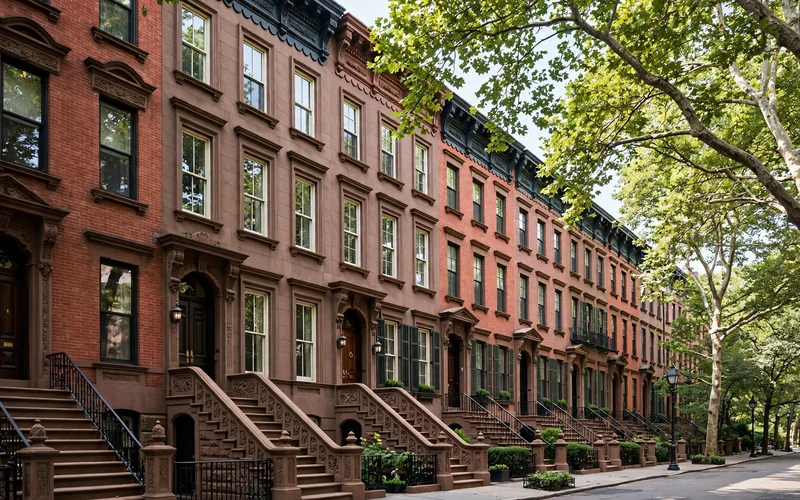
Yes, you can sell a landmarked house in New York City. Landmark status does not stop a sale, and the Landmarks Preservation Commission (LPC) does not have to approve the transaction itself. What landmark status does change is what the next owner can do with the house, and that shapes who will buy it, what they will pay, and how long the deal takes to close. If you own a brownstone in Park Slope, a row house in Brooklyn Heights, or a townhouse in a Greenwich Village historic district, the rules below decide whether your sale moves smoothly or stalls in due diligence. This guide explains what landmark designation means for a seller, the permits buyers will ask about, the unpermitted-work trap that follows the house from owner to owner, and the fastest ways of selling your house fast in New York, including selling as-is to a cash buyer.
What “Landmarked” Actually Means in NYC
A house can be landmarked in two ways. It can be an individual landmark, a single building designated on its own merits, or it can sit inside a historic district, a whole area designated together. Most landmarked houses in New York are the second kind: they are protected because of the block they sit on, not because of anything special about that one building.
The Landmarks Preservation Commission (LPC) was created in 1965, after the demolition of the original Pennsylvania Station, and it is the largest municipal preservation agency in the country. As of the end of Fiscal 2026, the Commission has designated more than 38,000 landmark properties across the five boroughs, including 1,473 individual landmarks and 159 historic districts and extensions, according to the city’s Mayor’s Management Report. Brooklyn Heights became the city’s first historic district in 1965. Today, Brooklyn holds some of the largest districts in the city, including Park Slope, Brooklyn Heights, and Bedford-Stuyvesant, alongside well-known Manhattan districts such as Greenwich Village and the Upper West Side.
What the LPC protects is the exterior of the building as seen from a public street: the facade, windows, doors, stoop, cornice, and roofline. Interior work is generally outside the Commission’s reach unless it needs a Department of Buildings (DOB) permit.
Does Landmark Status Stop You From Selling?
No. Nothing in the Landmarks Law prevents an owner from selling a designated property, and the LPC does not review or approve sales. Designation runs with the property, not with the owner, so the restrictions simply pass to the buyer at closing. The sale itself goes through the normal New York process: contract, attorney review, title search, and closing.
Where landmark status does slow a sale is in the buyer’s due diligence. A buyer’s attorney will check whether the house is an individual landmark or in a historic district, pull the LPC permit history, and look for violations or unpermitted work before the buyer commits. A traditional buyer with mortgage financing can also face appraisal questions if the appraiser cannot find enough comparable sales inside the same district. None of that blocks the sale, but it stretches the timeline and gives the buyer reasons to renegotiate.
What Landmark Status Does to Your Price and Buyer Pool
There is no simple rule that landmark status raises or lowers a price. Research from the NYU Furman Center, which studied decades of New York sales before and after district designations, found that designation raised property values within historic districts outside Manhattan, while properties inside Manhattan districts saw no greater gain than comparable properties nearby. Properties just outside a district’s boundary also gained value after designation. The Furman Center study concluded that the effect depends on the neighborhood: where the right to redevelop is worth little, the character and predictability a district provides tend to lift values, and where development rights are valuable, the restrictions weigh against the premium.
What is more predictable is the effect on your buyer pool. Landmark rules deter the buyers who want to gut a house, add floors, or rebuild the facade in a different style, because those plans need LPC approval and may be denied. The buyers who remain are the ones who want the house largely as it is. A smaller pool usually means a longer time on the market with a traditional listing and more room for buyers to negotiate, especially if the house also needs major repairs.
Condition still matters more than designation. A landmarked brownstone in good repair in a desirable district will draw strong interest; one with a failing roof, outdated systems, and unpermitted work will not, because the buyer inherits both the repair bill and the LPC process. Be honest about the property’s condition and its landmark status from the start: New York’s Property Condition Disclosure Statement asks sellers about known violations and claims affecting the property, and hiding landmark problems is the fastest way to lose a buyer after the contract is signed. Talk to your attorney about exactly what to disclose in your situation.
The Three LPC Permits Your Buyer Will Ask About
Any buyer planning work on a landmarked house will want to know which LPC permit applies, because the permit decides how long the work takes and whether it can happen at all. The LPC issues three types of permits, and the type depends on the work, not on the owner.
Certificate of No Effect (CNE)
A CNE covers work that needs a DOB permit but does not change the building’s protected architectural features, such as an interior renovation that requires a DOB permit or new rooftop mechanical equipment. It is reviewed by LPC staff, and the Commission says complete applications can often be approved within 10 business days, with a decision required within 30 business days after staff confirm the application is complete.
Permit for Minor Work (PMW)
A PMW covers work that affects protected features but does not need a DOB permit, such as replacing windows or doors, cleaning or repairing masonry, and restoring architectural details. It is also a staff-level approval, and the LPC charges no fee for it.
Certificate of Appropriateness (CofA)
A CofA is required when work changes significant protected features and does not qualify for staff-level approval: rooftop or rear-yard additions, demolitions, and removing or adding features such as stoops and cornices. This permit requires a presentation to the local community board and a public hearing before the full Commission, and it can take months. A buyer planning a rooftop addition should expect this timeline before making an offer, because it is often the single biggest surprise in a landmarked purchase.
The trigger for LPC review is not the size of the budget. It is whether the work changes something visible from a public way. Replacing a window with a historically accurate replica is usually a staff-level matter; changing the window’s proportions or material can move the same job into CofA territory.
Unpermitted Work: The Problem That Follows the House
The most expensive surprise in a landmarked sale is work a previous owner did without an LPC permit. The Commission’s position is that work done without a permit is the responsibility of the current owner, whoever did it. A violation issued for a prior owner’s windows, stoop, or rooftop addition stays with the property and becomes the buyer’s problem at closing.
Common examples include replacement windows in the wrong profile or material, a rebuilt stoop, a removed cornice, an enclosed porch, or a rooftop structure added without approval. A buyer’s attorney will check the LPC’s Permit Application Finder, which shows applications and permits for an address since January 1, 2016, along with DOB records for permits, violations, and sign-offs.
If unpermitted work turns up, you have three realistic options. You can apply to legalize it, which can be slow and may require restoring the original features. You can disclose it and price the house for a buyer willing to take it on, which usually means accepting less. Or you can sell the house as-is to a buyer who accepts the property with its LPC history. The same choice comes up with open permits and code violations: the paperwork problem does not disappear because you are the seller, so the question is who takes it on and at what price. Your attorney can tell you which path fits your situation.
How to Sell a Landmarked House in NYC
1. Find out exactly what is protected
Check the LPC’s Discover NYC Landmarks map to confirm whether your house is an individual landmark or inside a historic district, and read the designation report for your building. The report describes which features are protected, and it is the document a buyer’s architect will rely on. Knowing the answer before you list saves you from discovering it during a buyer’s inspection.
2. Gather your paperwork before you list
Pull together the designation report, any LPC permits and sign-offs, DOB permits, the certificate of occupancy, records of major repairs, and leases and rent registrations if there are tenants. A seller who can hand a buyer a complete permit history removes the biggest source of delay in a landmarked sale.
3. Price for the real buyer pool
Use comparable sales inside the same historic district, not just the same neighborhood, because the buyer pool and the LPC constraints are part of what the price reflects. If the house has unpermitted work or needs a CofA-level renovation, that belongs in the price. Overpricing a landmarked house with known problems usually costs more in time and price cuts than pricing it honestly from the start.
4. Decide how you want to sell
A traditional listing gives you the widest exposure but also the longest timeline: showings, buyer financing, appraisal, attorney review, and LPC due diligence. A direct sale to a cash buyer skips most of that. The buyer purchases the house as-is, with its landmark status and permit history, and you do not have to fix the facade, legalize old work, or wait for an LPC application. The trade-off is price: a cash offer will be below the top retail price, because you are trading some value for speed and certainty.
Selling a Landmarked House to a Cash Buyer
For many owners of landmarked houses, the as-is route is the practical one. The houses that are hardest to sell traditionally are the ones cash buyers handle routinely: a brownstone with a tired facade that cannot be reclad without a CofA, a row house with replacement windows installed by a previous owner, a property with an LPC violation attached. A cash buyer does not need a mortgage appraisal to come back clean, does not need you to complete repairs first, and does not ask you to resolve the LPC file before closing.
What changes is the math, not the process. The offer reflects the condition of the house and the cost and limits of working within landmark rules. In return, you get a written offer within 24 hours of sending the address and a closing date you choose, in as little as 7 days when title is clear. You accept only if the number works for you, and there is no obligation if it does not.
Frequently Asked Questions
Can you sell a landmarked house in NYC?
Yes. Landmark status does not prevent a sale, and the Landmarks Preservation Commission does not approve or review the transaction. The designation and its restrictions pass to the buyer at closing.
Do I need LPC approval to sell my landmarked house?
No. LPC approval is required for work on a landmarked building, not for selling it. Your buyer will need LPC permits for future work, but the sale itself needs no LPC sign-off.
Can the buyer renovate a landmarked house after buying it?
Yes, with the right permit. Minor exterior work and interior work that needs a DOB permit usually go through staff-level approvals, while major changes to protected features need a Certificate of Appropriateness and a public hearing. Interior-only work generally needs no LPC review unless it requires a DOB permit.
Does being in a historic district lower my home’s value?
Not necessarily. NYU Furman Center research found that designation raised values within historic districts outside Manhattan, while Manhattan districts saw no greater gain than nearby properties. The effect depends on the neighborhood, the condition of the house, and how much the restrictions limit redevelopment.
What if a previous owner did work without an LPC permit?
The responsibility passes to the current owner. Unpermitted work and any resulting LPC violation stay with the property, so the issue must be disclosed, legalized, priced into the sale, or taken on by an as-is buyer.
The Bottom Line
A landmarked house in New York City is sellable, and often desirable, but it is not an ordinary sale. The designation does not block the transaction, yet it narrows the buyer pool, adds a layer of due diligence, and makes unpermitted work a problem the next owner inherits. Owners who check their landmark status, gather their permit history, price for the real buyer pool, and disclose known problems give themselves the smoothest path to closing. If the repairs, the LPC process, or the timeline are more than you want to take on, an as-is sale removes them from your side of the table. To see what that looks like for your house, get a cash offer for your landmarked property: send the address, get a written offer within 24 hours, and close on a date you choose.

Jeff is part of the team at Cash Buyers NY, a cash home-buying company serving New York City and Long Island from Bellerose, Queens. The company buys houses as-is in any condition — no repairs, no agents, no commissions, and no financing contingencies — through a straightforward cash-offer process. Jeff covers the questions New York homeowners actually ask: how long a cash sale takes, what it costs, how co-op boards and inheritance work, and when selling as-is makes sense.