
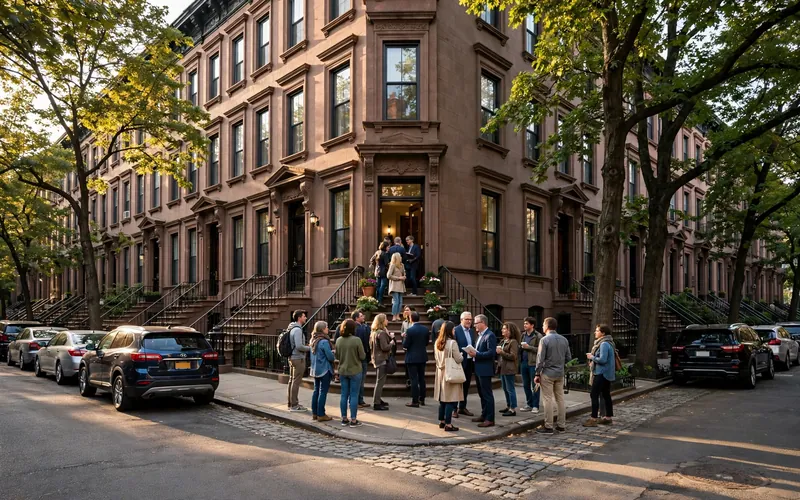
If you have been watching the New York City housing market this year, you may have noticed something familiar: multiple buyers circling the same listing, offers flying past the asking price, and agents talking about “highest and best” again. After a cooler stretch, fresh 2026 data shows competition is genuinely back in parts of the city. If you own a home in NYC or Long Island and have been wondering whether this is your moment to sell your house fast in New York, here is a data-driven look at what is really happening, how over-ask sales work, and whether your home is likely to benefit.
Are Bidding Wars Really Back in NYC in 2026?
Yes. According to StreetEasy’s August 2026 sales market report, 25.0% of NYC homes sold above asking in July 2026 — the highest share since July 2022 — followed by 21.8% in August, up from 20.5% a year earlier. That is roughly one in five completed sales going for more than the last asking price, despite mortgage rates far above the lows of a few years ago.
That stands out because the national picture looks different: in September 2026, only 16% of U.S. homes sold above list, down from 21% a year earlier, per the National Association of Realtors’ September survey. New York is running against the grain — national headlines rarely describe local reality. Between April and July 2026, 18 of 21 weeks saw year-over-year increases in new signed contracts, while inventory fell 5.0% to 15,324 homes for sale.
Where the bidding is hottest: borough by borough
In August 2026:
- Brooklyn led the city at 31.9% above asking, with its Q3 median sale price up 5.4% year over year to $1.15 million (Douglas Elliman’s third-quarter report).
- Queens was second at 24.2% above asking, and offers the most options: inventory rose 3.3% while every other borough shrank.
- Manhattan trailed at 16.0% above asking, though the median co-op and condo price hit a record $1.25 million in Q3, up 6% year over year (Elliman).
The neighborhood contrast is sharper still: in August, 61.3% of Park Slope sales went above ask, followed by Greenwich Village at 40.0%, Bedford-Stuyvesant at 34.8%, and Forest Hills at 30.4%.
Why Buyers Are Competing Again
Several forces are converging. First, years of sidelined demand are spilling over from the rental market: StreetEasy reported the median asking rent hit a record $4,200 in August 2026, pushing plenty of long-term renters to buy.
Second, the remaining buyer pool skews strong: with the 30-year fixed rate at 7.40% in early October (up from 6.30% a year earlier, per Freddie Mac’s weekly mortgage survey), marginal buyers are priced out — those left are well-qualified, often with large down payments or cash, and bid without financing worries.
Third, scarcity does the rest: Manhattan’s sales inventory dropped 11.2% year over year, so the homes that hit the market at a sensible price attract crowds. Higher rates didn’t kill demand — they made buyers more selective, concentrating competition on the best-priced, best-presented listings.
How an Over-Ask Sale Actually Happens
When a listing draws multiple offers, the seller sets a deadline and asks for each buyer’s “highest and best.” Here is what buyers typically offer beyond price — and what it means for you. Our broader guide to navigating a competitive New York market covers the bigger picture.
Appraisal gaps
An appraisal gap happens when the lender’s appraiser values the home for less than the agreed price. Lenders size the loan on the lower of the two figures, so without a fix the deal gets renegotiated or falls apart. In competitive offers, buyers frequently agree in writing to cover a shortfall in cash on top of their down payment — for sellers, an offer with appraisal-gap coverage is far stronger than a higher offer without it. Nationally, 18% of buyers waived the appraisal contingency entirely in September 2026, per NAR.
Waived inspection and financing contingencies
Every contingency is an escape hatch for the buyer — and a risk for the seller. In bidding wars, buyers often waive the inspection contingency, the mortgage contingency, or both, sometimes after a pre-inspection. A waived financing contingency means the buyer closes even if their loan falls through — which is why all-cash offers remain the gold standard: no loan to deny, no appraisal to miss, no weeks of bank underwriting.
Escalation clauses and best-and-final deadlines
An escalation clause lets a buyer automatically outbid any verified competing offer by a set increment — say $2,500 or $5,000 — up to a maximum cap, staying competitive without revealing their full maximum upfront. Sellers then compare escalated prices alongside terms and pick a winner, often countering on timeline or deposit.
One New York wrinkle: in Manhattan, where co-ops and condos dominate, winning the bidding war is only step one — co-op boards must approve the buyer, a process that can take weeks and sink deals that look great on paper, so sellers routinely prefer a lower offer from a board-ready buyer.
Which Homes Attract Bidding Wars — and Which Don’t
Bidding wars are won by homes that are move-in ready, priced in line with recent comparable sales, and marketed aggressively. StreetEasy found above-ask sellers stood out on buyer engagement — a median listing performance score of 73.5%, versus 55.8% for homes that sold at or below ask. Saves, views, and open-house traffic mattered more than the asking price itself.
The flip side is just as clear. Homes that rarely see bidding wars include:
- Overpriced listings — a price disconnected from comparable sales sits, then gets reduced.
- Homes needing major work — buyers bidding over ask want to move in, not renovate.
- Properties with legal baggage — open code violations, unresolved permits, tenant complications, or estate and title issues make traditional buyers and their lenders nervous.
The uncomfortable truth: bidding wars are not lifting every home. They are concentrating on a subset of desirable, problem-free properties — waiting for one to rescue a problem property is usually the wrong bet.
Should You Sell Your NYC Home in 2026?
Whether the current market is your market depends less on citywide statistics and more on your situation:
Does your home fit the bidding-war profile? If it is in good condition, in a neighborhood where above-ask sales are common, and you price it to attract a crowd rather than test the ceiling, 2026 conditions favor you.
Where will you go next? The classic seller’s-market trap: you sell high, then buy high — competing in the same bidding wars as a buyer. If you are leaving the area or downsizing, the math is cleaner. If you need to buy another NYC home, factor that in before listing.
Have you accounted for the true cost of selling? Transfer taxes alone run 1% of the price up to $500,000 and 1.425% above that for residential property (per the NYC Department of Finance’s transfer-tax rates), plus the state transfer tax of 0.4% — roughly 1.8% combined on a typical sale, with an additional mansion-tax layer at $1 million and up. Add broker commissions, attorney fees, and months of carrying costs, and the “record price” shrinks meaningfully. (Tax rules change; confirm current figures with a qualified professional.)
Is your timing flexible? Seasonal timing still matters in the New York market — but don’t list before the home is genuinely ready. A rushed listing that lingers becomes stale, and stale listings don’t get bidding wars.
When a Cash Sale Beats the Bidding War
Here is where honesty matters more than hype: not every home can compete for a bidding war, and not every seller wants the months-long process a traditional listing demands. If your house needs significant repairs, carries code violations, is tenant-occupied, or is tied up in an estate, chasing the open market can mean price reductions, failed inspections, and deals collapsing over appraisals.
A direct cash sale sidesteps the entire bidding-war apparatus: no appraisal, no financing contingency, no inspection renegotiation, no board gauntlet, and no months of showings. You trade the small chance of an over-ask frenzy for a firm offer on your timeline — which nets out better once you subtract commissions, repair credits, and carrying costs. Here is how long a cash sale typically takes in NYC.
Frequently Asked Questions
What percentage of NYC homes sold above asking in 2026?
In July 2026, 25.0% of NYC homes sold above their last asking price — the highest share since July 2022 — followed by 21.8% in August, according to StreetEasy. Brooklyn led at 31.9% above asking in August, versus 24.2% in Queens and 16.0% in Manhattan.
Do I have to accept the highest offer in a bidding war?
No — weigh terms alongside price. An offer with appraisal-gap coverage, waived contingencies, a large deposit, and flexible closing terms is often stronger than a higher offer with more escape hatches. In Manhattan co-ops, the buyer’s likelihood of passing board approval matters too.
What is an appraisal gap, and who pays it?
An appraisal gap is the difference between the agreed purchase price and the lender’s appraised value when the appraisal comes in low. Lenders base the loan on the lower figure, so the buyer typically covers the gap in cash — often agreed in advance through an appraisal-gap coverage clause. Without it, the parties must renegotiate or the deal may fall through.
Are bidding wars happening in Manhattan too, or just Brooklyn?
They are happening everywhere, but unevenly. Manhattan’s 16.0% above-ask share in August was roughly half of Brooklyn’s 31.9%, and Manhattan homes took longer to go into contract (a median of 93 days versus 69 in Brooklyn). Manhattan is also more co-op and condo driven, so board approval adds a layer that doesn’t exist for most Brooklyn and Queens houses.
If my home probably won’t attract a bidding war, should I still list it?
It depends on the reason. If the home needs work, has violations, or has legal complications, a traditional listing often leads to lowball offers, inspection renegotiations, and long market time. In those cases, a direct as-is cash offer can be the cleaner path — request one and compare it against realistic listing expectations before deciding.
The Bottom Line
NYC bidding wars are genuinely back in 2026 — not as a citywide frenzy, but as concentrated competition for well-priced, move-in-ready homes, strongest in Brooklyn and select neighborhoods elsewhere. If your home fits that profile and your next move is sorted, listing into this market can pay off. If your property can’t compete on those terms, or you value certainty and speed over the gamble of an auction-style sale, a direct as-is cash sale may leave you better off once the real costs of listing are counted.
The decision should be based on your home and your timeline — not the headlines. To see what your NYC or Long Island home could fetch without listing, get a free, no-obligation cash offer from Cash Buyers NY (646-920-8900) and compare it against the market on your own terms.

Jeff is part of the team at Cash Buyers NY, a cash home-buying company serving New York City and Long Island from Bellerose, Queens. The company buys houses as-is in any condition — no repairs, no agents, no commissions, and no financing contingencies — through a straightforward cash-offer process. Jeff covers the questions New York homeowners actually ask: how long a cash sale takes, what it costs, how co-op boards and inheritance work, and when selling as-is makes sense.